
Durham’s LDC Update: What Homeowners Need to Know
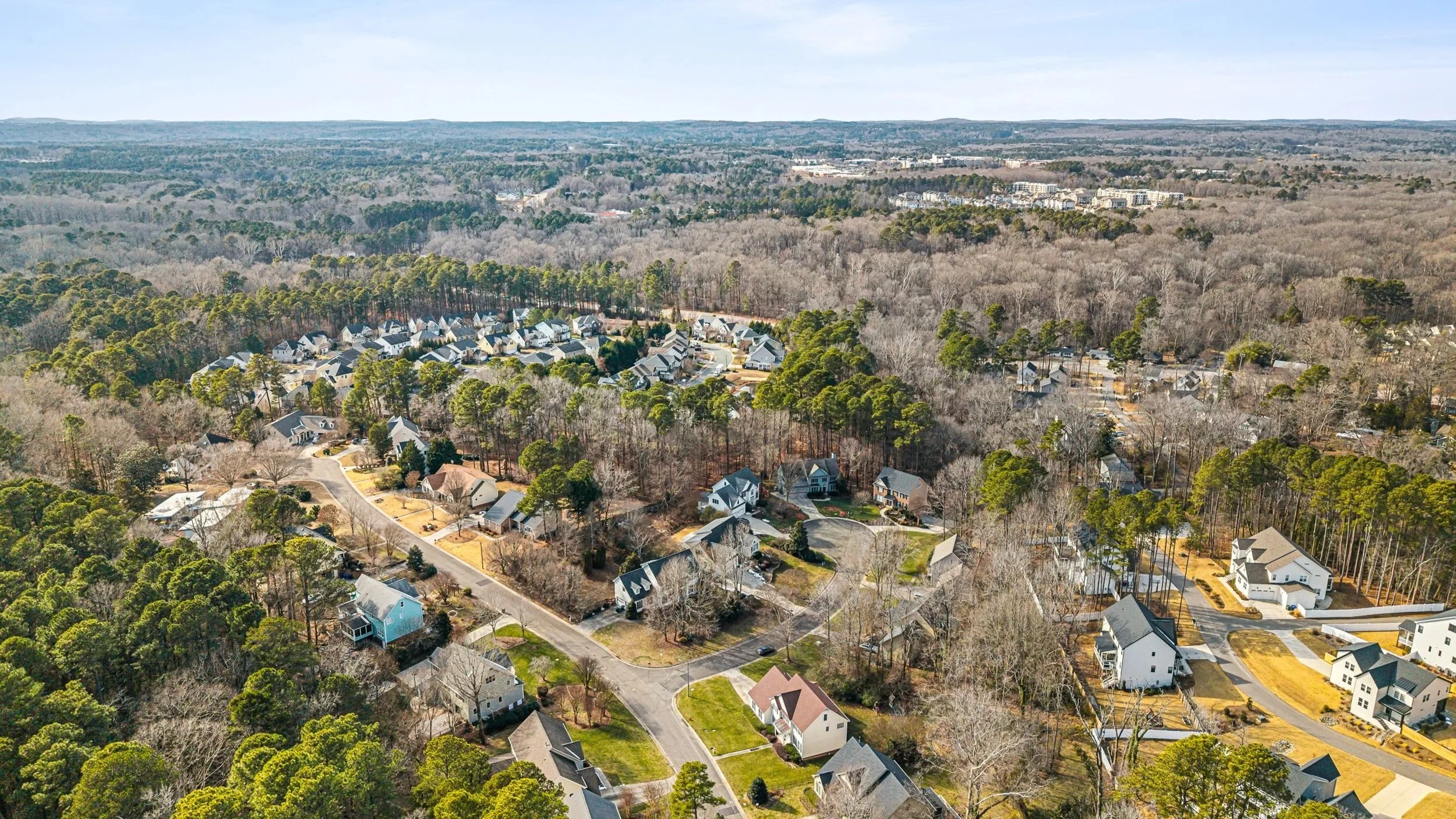
A picture of central Durham & how different zoning codes in have created different type of neighborhood
Over the past week, Durham residents received a letter stating that they “occupy or own a property that will be affected by the anticipated adoption of the new Unified Development Ordinance, called the Land Development Code.” As a realtor, I have gotten a few calls on this matter.
In this article, I want to explain what is happening with the Land Development Code (LDC), why it is being updated, and what it could mean for you.
What Is the LDC (formerly the UDO)?
The Land Development Code—formally known as the Unified Development Ordinance (UDO)—is the set of rules that governs what can be built and where it can be built. Every city and county has its own set of rules/development code. An example of this is how Baltimore has their famed row houses, but that housing type has not been allowed in Durham for the last 50 years. (until SCAD passed in 2023)
You see the effects of these rules every day. For example, housing in downtown Durham is more dense, while properties in southern or suburban Durham tend to sit on larger lots. That difference is not random—it is the result of zoning regulations. The LDC also restricts housing types in different zoning codes. There is not a single family detached house on Ninth Street because it is zoned Commercial General (CG) and that housing type is not allowed in CG.
A pattern you might notice is when you move farther from the urban core, minimum lot sizes increase for a residential unit. (for example, from 5,000 square feet (0.11 acres) to 10,000 (0.23 acres) or even 20,000 square feet (0.46 acres)). That pattern is the development code at work. The new LDC will essientally make most lots in Durham a 5,000 SF minimum.
Why Is It Being Updated?
In October 2023, the City and County adopted a new Comprehensive Plan. That plan laid out long-term goals for growth, housing, and land use. As a result, the development code needed to be updated to align with that vision.
Since early 2024, City and County planning staff have been drafting revisions on their Engage Durham Website. Three modules have been released, multiple public hearings have been held, and staff have hosted office hours and community sessions to explain the proposed changes. The full draft was released on 1/29/2026 and you can check it out here!
What Are the Major Changes?
One of the most significant updates is the consolidation of residential zoning into four districts:
Residential Preserve (R-A) - Very low-density residential areas with large lots (minimum 3 acres). Allows one- and two-unit homes with accessory dwelling units (ADUs).
Residential Suburban (R-B) - Traditional low-density suburban development. Allows one- and two-unit homes and ADUs on lots of at least 20,000 square feet.
Residential Manufactured Home Park (R-C) - Allows clusters of small detached homes, including manufactured homes, tiny homes, and RV parks, on lots of at least 15,000 square feet.
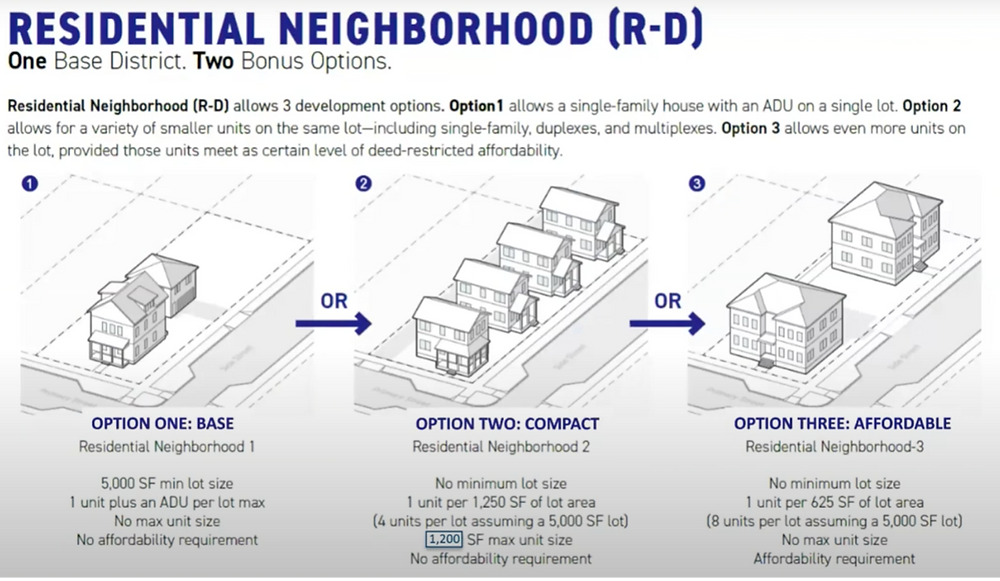
Residential Neighborhood (R-D) - Designed to support compact, walkable neighborhoods with a broader range of housing types, including single-family homes, duplexes, ADUs, multiplexes, cottage courts, and limited townhouses.
R-D has three flexible buckets you can elect into:
Base Option: Minimum lot size of 5,000 square feet with min 50 ft of frontage. This is your base/standard option.
Compact Option: Allows smaller lots and higher density. You can have 1 unit per 1,250 SF of lot. These homes are restricted to a max 1200 SF heated SF on a max 800 SF building footprint. If you have a 10,000 SF lot, you lot could fit 8 units. (10,000 SF/1250 SF=8 units) With this compact option, your housing also increase.
Affordable Option: Allows greater density and flexibility when at least 8% of units are deed-restricted affordable housing. You can have 1 unit per 625 SF of lot. If you have a 10,000 SF lot, you lot could fit 16 units. (10,000 SF/625 SF=16 units)
What Does This Mean for You?
In practical terms, you may have more flexibility than before. That could mean:
Adding an ADU
Subdividing or building an additional unit
Developing cottage-style housing (where permitted)
Or simply keeping your property exactly as it is
Development does not occur simply because it is allowed—it happens when market demand supports it. For example, the market is not pushing for apartment buildings in the middle of Hope Valley. Feasibility depends on infrastructure (water and sewer access), topography, lot configuration, and neighborhood context, among other factors.
Why Is the City of Durham Making These Changes?
At its core, this update is about housing supply.
Durham’s leadership has made it clear that the city needs more housing at a range of price points. The Land Development Code update is designed to allow more homes to be built, reduce procedural barriers, and simplify the development process. By reducing regulatory complexity and lowering minimum lot sizes in certain districts, the city is attempting to make building both cheaper and more predictable.
Zoning rules directly influence the financial feasibility of development. For example, if a 10,000-square-foot lot can accommodate eight units instead of one or two, the underlying land value changes. In some cases, the land may become more valuable than the existing structure sitting on it. That shift in economics opens the door for small, local, incremental builders to participate in adding housing—rather than development being limited to large-scale projects.
If additional units are added across many properties over time, overall housing supply increases. Basic market dynamics suggest that when supply rises and demand remains relatively stable, upward pressure on prices can moderate. Durham has already seen a version of this effect through its 2018 Expanding Housing Choices reforms. While prices have continued to rise, the rate of increase has been flatter compared to nearby markets like Raleigh and Chapel Hill.
It is important to understand that zoning reform does not produce immediate results. There is typically a two- to three-year lag between code adoption and visible market impact. Projects must be designed, permitted, financed, and constructed before new housing reaches the market. The LDC update is therefore a long-term structural change aimed at shaping how Durham grows over the next decade—not just the next year.
What About the New Zoning Map?
With the adoption of the new LDC, Durham will also adopt a new zoning map. One clear pattern in the proposed map is that most properties connected to city water and sewer are designated R-D.
Importantly, your lot is not getting smaller. However, the range of potential uses for your property may expand. Under R-D, a homeowner may choose whether to remain as-is or explore options such as additional units, depending on site conditions and market demand.
Current UDO | Future LDC
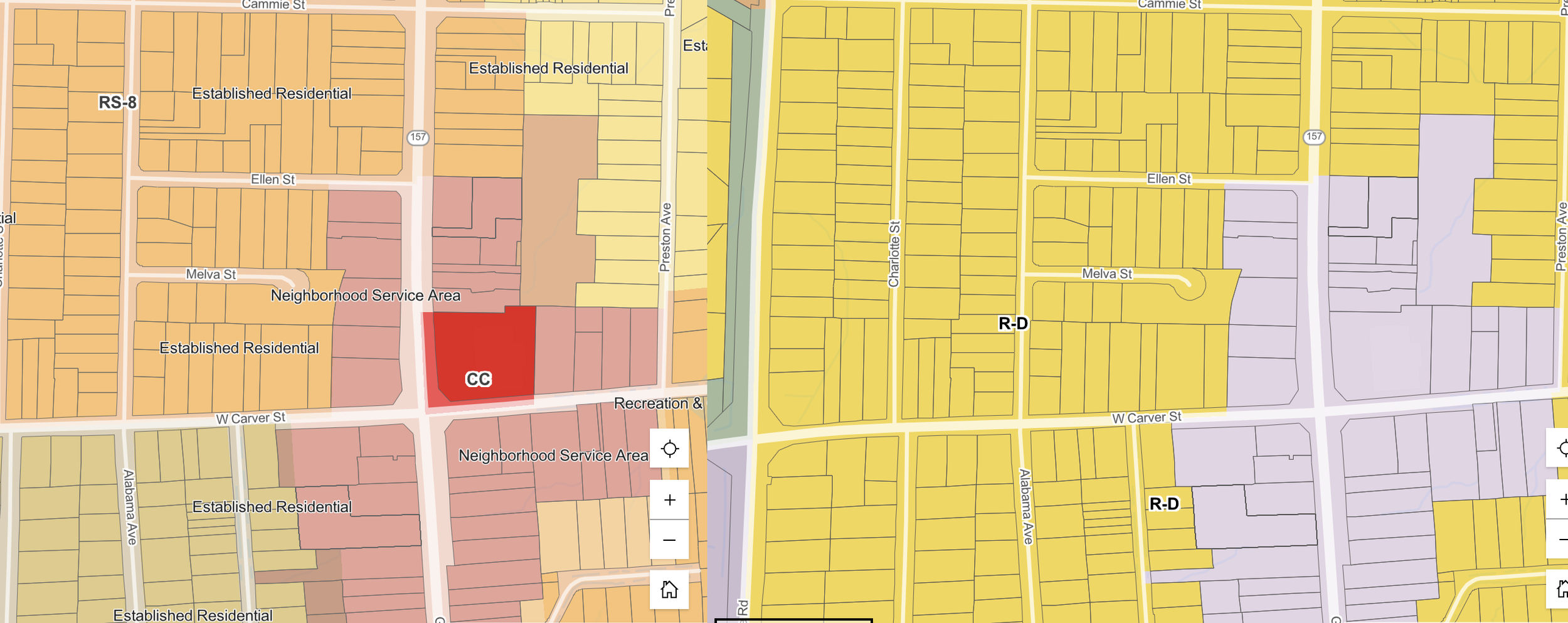
This picture is from the City of Durham Zoning Slider comparing the current UDO and the future LDC. On the left, (Current UDO) you have CC, RS-8, RU-5, RU-5(2), CN. On the Right, (future LDC) you have just CX-3 & R-D.
Other Code Updates
Beyond zoning districts and lot sizes, the new LDC also updates setbacks, height requirements, "small lotting” a house built before 1975, and other dimensional standards. A major goal of the rewrite is simplification—making the code clearer and more consistent.
The Bigger Picture
Adopting this new code and zoning map is a significant step for Durham. The city has already been proactive—expanding housing choices in 2018 and adopting SCAD in 2023. This update builds on that momentum and allows for more housing types in more places.
Final Thoughts
Durham is growing, and how we regulate land use will shape what that growth looks like for decades. The Land Development Code update is not about forcing change on neighborhoods overnight—it is about creating a framework that allows more housing options, reduces unnecessary barriers, and gives property owners greater flexibility.
Whether you plan to build, add an ADU, explore development potential, or simply stay informed, understanding the rules puts you in a stronger position. If you are curious about what these changes mean specifically for your property, I am always happy to walk through it with you.
Curious about the affects of your property?
Fill out the form below, and I can give you a quick assesment on what new opportunities might be available to you.

About the Author
Matt Lunceford Blivin was born and raised in Durham and now works in real estate here in the city he calls home. He is passionate about housing and believes Durham can grow in ways that are thoughtful, incremental, and responsive to real demand. Through his work, he focuses on helping clients understand both the market and the regulatory landscape that shapes it.
Outside of real estate, Matt is a dedicated Duke fan and an avid runner. You may spot him training for his next marathon along the Ellerbe Creek Trail early in the morning.
