
Ep. 1 : Small Lots, Big Impact: How EHC & SCAD Are Reshaping Housing in Durham | 217 Gresham Ave
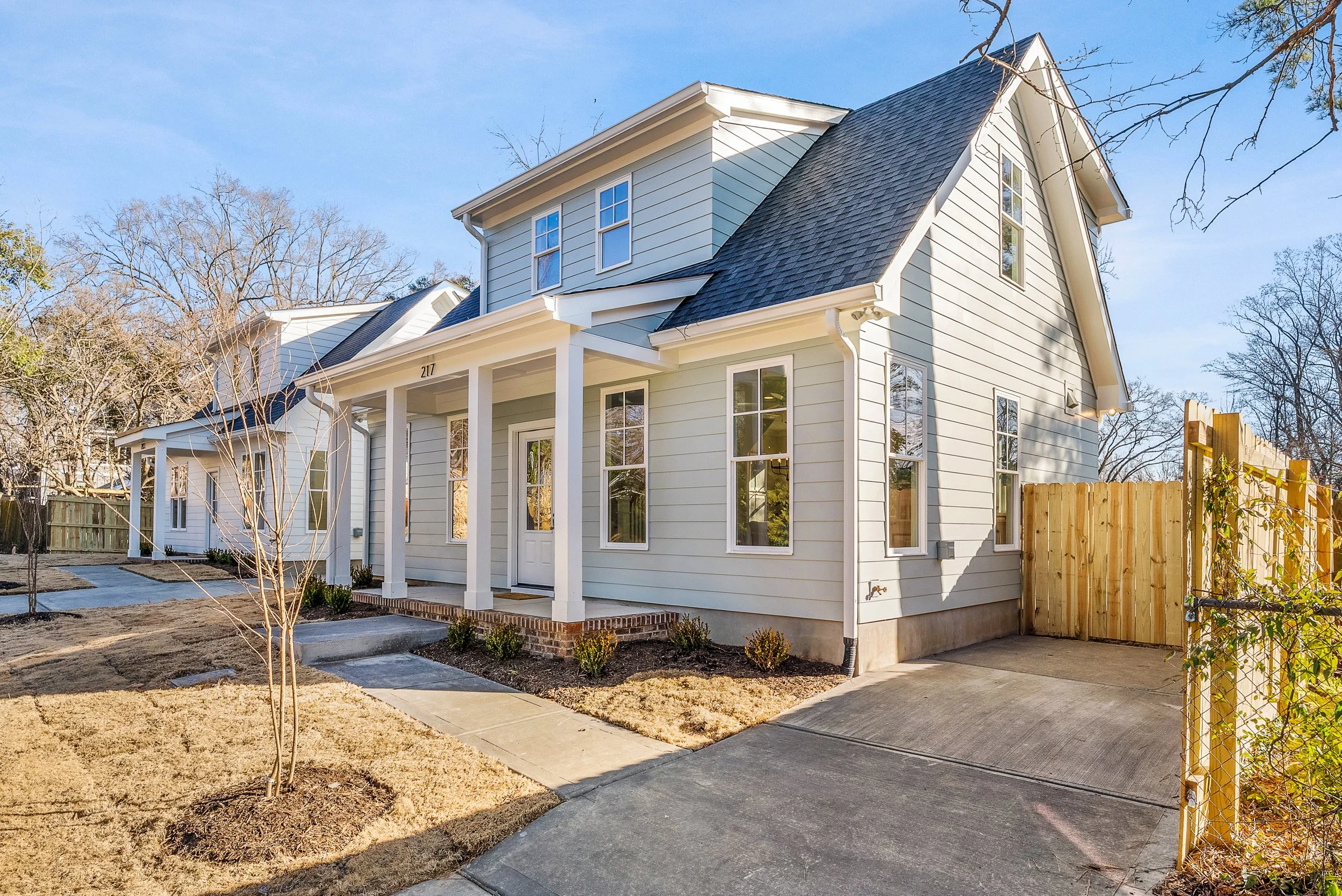
217 Gresham Ave is housing opportunity made possible through Exanding housing choices and SCAD.
This is a story about how Durham’s small-lot code(Expanding Housing Choices)—paired with SCAD (Simplifying Code for Affordable Development)—has unlocked new housing types through thoughtful infill.
The home pictured above sits on Gresham Avenue in Northgate Park. This home was built by a local building company right here in Durham, who employees local subcontractors and sources local materials. (Thank you Talbert’s!) It’s a 1,200-square-foot house built in 2026 on a small lot, fitting comfortably into a post–World War II neighborhood where most homes range from 800–1,200 square feet on lots generally between 7,500 and 11,000 square feet. These properties are zoned RU-5 and reflect a typical platted community of that era.
Northgate Park has long been a landing spot for Durham’s starter homes. The housing stock is modest in size, and prices typically fall between $300,000 and $600,000. Smaller square footage helps keep prices relatively attainable—but the combination of small homes on large lots has also made the neighborhood a prime target for sensitive infill and expansion.
I’m personally aware of nine different projects in Northgate Park that have collectively added 28 new homes. In seven of those cases, the original house was preserved while the lot was reduced to accommodate one or two additional units. A clear example of this approach can be found at 217 Gresham Avenue.
Another illustrative case is 2618 Elgin Street,(Listed by Nico Crecco @ Compass) which came on the market last March. The existing home was a 901-square-foot, two-bedroom, one-bath house listed at $425,000. It went under contract within 24 hours, and one month later my clients purchased it for $435,000—about $483 per square foot. Notably, two of the three highest price-per-square-foot sales in the neighborhood were located on corner lots.
This particular house sits at the corner of Elgin and Gresham on a 0.26-acre (11,325-square-foot) lot, zoned RU-5. From a land area perspective, the parcel easily supports two lots. However, historic zoning restrictions limited it to one. Complicating matters further, the City of Durham never extended sewer down Gresham when the neighborhood was originally developed, even though it had been planned as a through street.
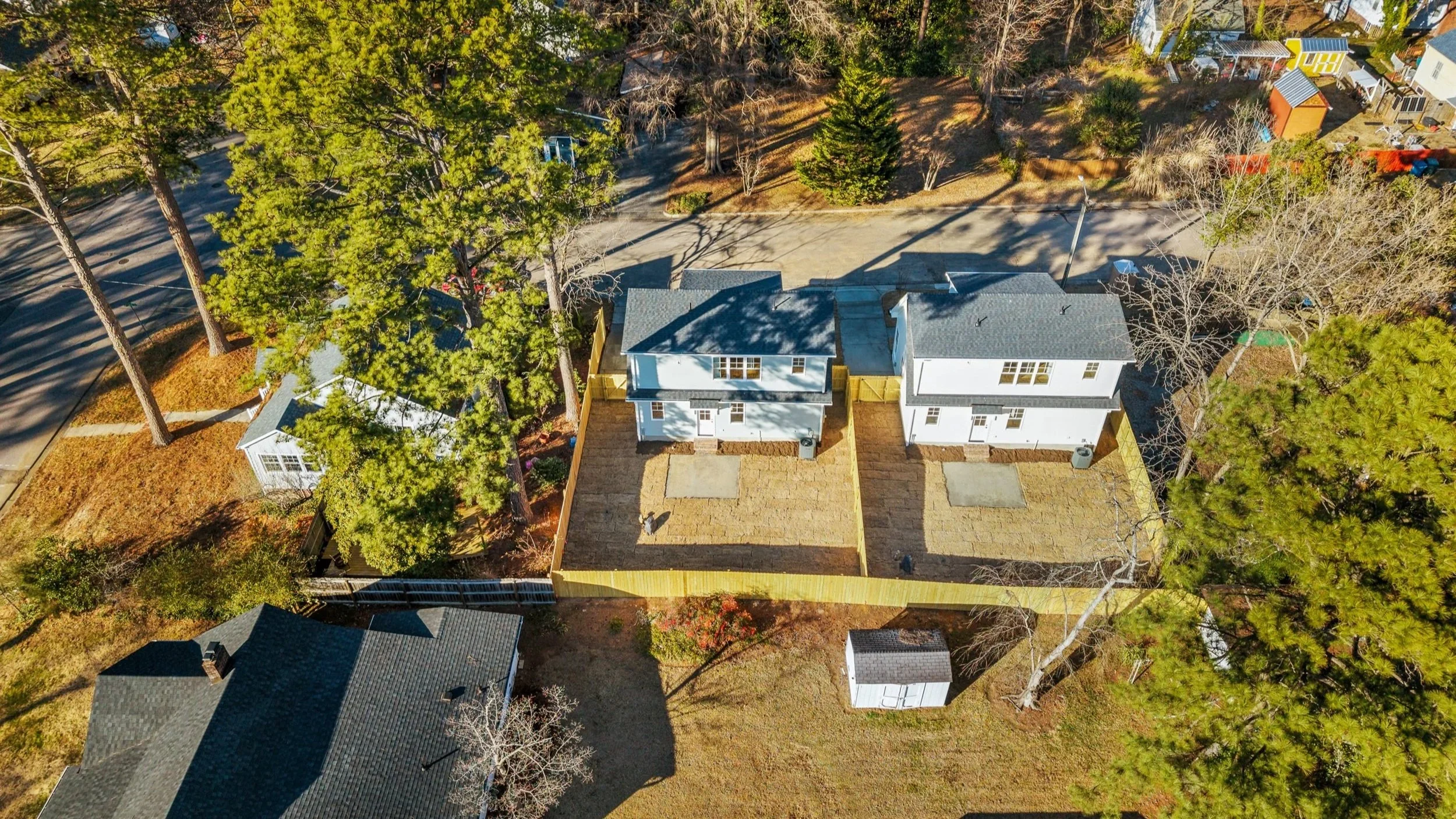
2618 Elgin St still protected by some gorgeous Loblolly Pines, with 2 new houses (213 & 217 Gresham Ave) located in its former backyard.
This is where Expanding Housing Choices (EHC) passing in 2018 and Simplifying code for Affordable Development (SCAD) passing in 2023 changed the equation. Together, these reforms made the 0.26-acre parcel eligible for two additional buildable lots (three were possible, but market conditions supported two). 217 Gresham Ave (Listed by Matt Lunceford Blivin @ Compass)became possible because of these zoning changes, and text amendments. EHC updated code significantly with reducing minimum setbacks—10 feet in the front yard, 5 feet on the sides, and 15 feet in the rear—and lowering the minimum lot size for a single-family home to 2,000 square feet in the urban tier. With the addition of these lots qualified as exempt plats, this shaves months off the subdivision timeline for the developer. In return, this changes has spurred small, local developers to be the ones shaping this change and benefitting from this dynamic zoning provisions.
The SCAD text amendments pushed this forward in 2023. SCAD allowed this pre-1950 homes to be subdivided using the small-lot provisions (reducing setbacks & min lot size) and reduced required utility flag widths from 10 feet to 5 feet. (Those 5 feet make a big difference!) Collectively, these changes have had a meaningful impact on Durham’s housing landscape.
Using these provisions, we were able to keep the original 1941 house at 2618 Elgin Street and add two new housing options. We “small-lotted” the existing home to reduce its setbacks and lot size, installed two utility flags along the side yard to connect to sewer, and created two additional buildable lots—all while preserving neighborhood character.
In addition to constructing two new single-family homes, we resold the original house after completing light renovations and addressing 25 inspection items at no cost to the buyer. Following subdivision, the home sold in May for $400,000—$35,000 less than our original purchase price.
From a fiscal standpoint, the impact is just as meaningful. Where this property once generated $3,647 per year in property taxes, the two newly constructed homes are each expected to contribute roughly $5,000 annually. That’s an additional $10,000 per year flowing into the City of Durham’s budget—revenue that can be directed toward capital-A Affordable Housing, park improvements, or the smaller infrastructure projects that often struggle to find funding.
This is what incremental density looks like in practice. It’s about creating more housing options for a friend who wants to be able to live close by, for the couple that are first-time-home-buyers, or a parent who wants to stay in the neighborhood to help with the new grandchild. It’s a repeatable, neighborhood-scaled pattern that steadily adds supply and meets the real demand Durham faces today. (and preliminary data shows helping suppress SFH pricing) Along the way, incremental density helps fund public projects across the city—without fundamentally changing the character of its neighborhoods.
Small-lot infill proves that thoughtful development can expand housing choices, strengthen neighborhoods, and quietly move a city forward, one lot at a time. This isn’t a theory or a pilot program—it’s happening now, block by block, reshaping Durham’s housing future.
P.S. I bought my first home just around the corner in 2021 for $255,000. My wife and I renovated and breathed new life into an 810-square-foot house on a 0.21-acre (9,324-square-foot, 55’ × 170’) landlocked lot. As both a resident and a developer, I’m genuinely excited to see this kind of housing evolution happening in my own neighborhood. I am a proud #YIMBY

About The Author
Matt Lunceford Blivin was born and raised in Durham and now works in real estate here in the city he calls home. He is passionate about housing and believes Durham can grow in ways that are thoughtful, incremental, and responsive to real demand. Through his work, he focuses on helping clients understand both the market and the regulatory landscape that shapes it.
Outside of real estate, Matt is a dedicated Duke fan and an avid runner. You may spot him training for his next marathon along the Ellerbe Creek Trail early in the morning.
